When books bring chaos instead of growth: how I built an analysis system and read 12 books a month

- February 25, 2025
Have you ever noticed that a month after finishing a book you only remember a vague “something about habits”? I ran into this constantly. Until I realised: reading for the sake of reading isn’t mine. I’m an analyst to the bone, and I need to put books on shelves: context, era, author, their motives. That’s how I refused to read until I created a system where every book becomes a mini-research project. And you know what? In January 2025 I read 12 books with full analysis. It’s real — and I’ll tell you how it works.
Why plain reading doesn’t work
Imagine: you’ve just finished an amazing book. It inspires you, changes how you see the world. And a couple of weeks later only fragments remain in your head. Familiar? That was me for years. I couldn’t make myself read until I invented an analytics system. Reading became not just a process but a small adventure with a deep analysis. Now every book isn’t just pages but a whole story I understand and remember.
In 2025 I launched a personal challenge: read every day. And here’s the result — 12 books in January, each with analysis. It’s like the cherry on the cake: the reading process gets tastier thanks to the research.
My approach to book analysis: Sherlock Holmes in the world of literature
Yesterday in my stories I shared thoughts on Chuck Palahniuk and my approach to analysing books. The response was amazing! I analyse books not just as text but as a puzzle:
- Context: what was happening in the world when the book was written?
- Era: how did the times influence the author?
- The author’s personality: what did they live by, what inspired them, what illnesses or disorders did they have?
Yes, it matters to me! For example, knowing that Palahniuk was influenced by his work in a hospice, I understand his cynical style more deeply. This approach turns reading into a fascinating investigation.
And so I decided to share the mini-template that helps me analyse books easily and quickly.
What is my book analysis template?
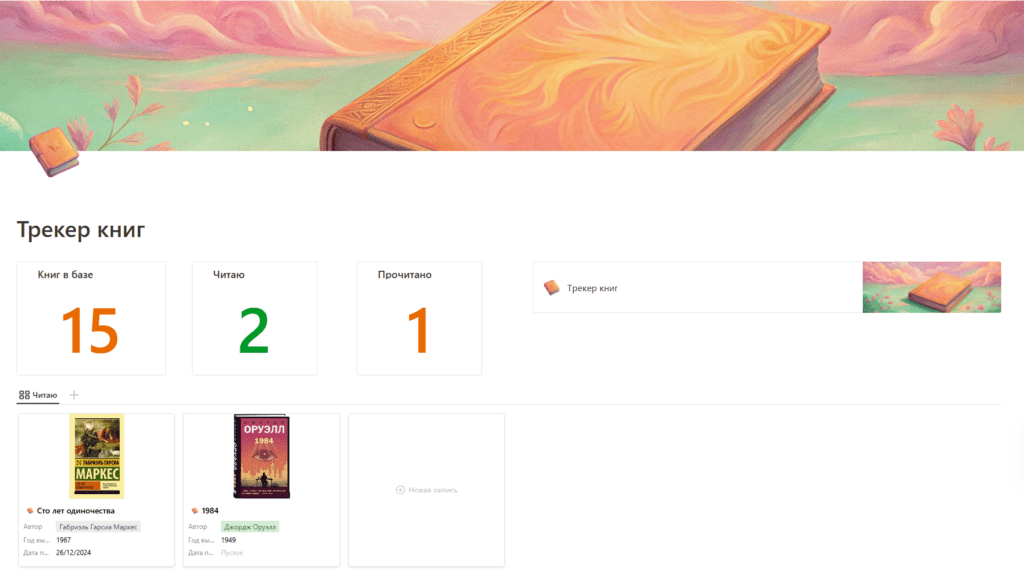
It’s a simple tool that turns a chaos of notes into an organised system. Here’s how it works:
The template’s main functions
- Notes: write down the key ideas of the book.
- Analysis: examine the context, era, the author’s motives — like a real detective.
- A database: tags by genre, author, status (read/in progress).
Who is it for?
- Those who want to write deep reviews, not just “cool book”.
- Owners of book blogs.
- Book worms who love order in what they’ve read.
Download the template, and in 5 minutes your books will turn into a perfectly organised library.
Download the book tracker right now
How can the template be improved? Share your ideas!
This template is just the beginning. If you have ideas on how to extend it (new categories, features, approaches), write in the comments! I plan to keep developing it and make it even more convenient for book enthusiasts.
Why a book analysis system changes everything
Now I don’t just read — I live through every book. Analytics helps me remember details, find connections and enjoy the process. 12 books a month isn’t a limit but a start. Try my approach and see for yourself: reading can be not chaos but a system of growth.
Download the tracker, start analysing and share your impressions in the comments. Which book will you analyse first?
FAQ
How do I read books so they don’t get forgotten?
How many books can you read with analysis in a month?
Do I need a template for book analysis?